Wednesday, March 10, 2010

Rising Water

Parked outside late tonight. Water is almost over the bridge.  There is too much snow on the ground. We have just about a foot of snow in the woods left, but I can imagine the snowpack is that much higher in the high country. This weekend could get ugly if we receive even an inch of rain - timing and amount will be critical.  Our road may end up downstream...

This morning I went out to the car right around 6 am. Just as I opened the car door I heard a plaintive cry of what I imagined to be a Canadian goose.  I stood there for a minute staring upward into the darkened, morning sky trying to pick out that familiar shape.  The light just hadn't made enough headway over the eastern mountain.  Again, that same call echoed across the valley.  Again, the call faded off into the distance, but not before I hesitated, a bit ill-at-ease with what I had just heard.  It isn't hard for me to latch on to an Aboriginal perspective, if I should even know or sense what that is.  But for a few seconds, then down the half-mile lane and off to town, just shy of fifteen minutes as the car flies - to work.

Back home this evening, close to 6 pm.  Snow has had a chance to melt a bit today with the temperature in the 40s (degree Fahrenheit). The water still has maybe two feet to rise before making it to the bridge deck.  But, I decide to park the car on the other side of the bridge tonight.  The last thing we need is to be marooned without a vehicle on the outside. I wait until 9:30 pm or so before I head back into town to pick up milk and other odds and ends just in case. As I head down our lane I bump into a furry, black butt ambling down the road.  The deep snow channels most furry friends along the same paths and this neighborly skunk is doing the same.  He steps up his pace as he realizes someone is tailgating him. This lasts for twenty yards or so when Mr. Skunk reaches the bridge.  He discovers he has reached the bridge just in time to encounter a fellow night critter, an oppossum.  I smile as I watch Mr. Oppossum and Mr. Skunk apparently discover they had no intent on meeting tonight.  Mr. Oppossum bares his teeth at Mr. Skunk and that is enough to send our furry friend along his way - still along the road.  Given that our friends met on the bridge I gently nudge Mr. Oppossum along and out of my way as he finally stumbles off the maintained road into the crusted and wet snow.  His trail isn't quite so comfortable now.

The trip into town takes a bit of time, but eventually I make my way back home and realize the water is rising faster than I had thought earlier.  I had hoped the slowly dropping temperature might allay the water level from rising any further.  No such luck.  I drop off the milk at the house (but not before chasing a red fox up our lane) and return to the main road to park my car.

It is on the walk back that I remember the day.  The goose above in the night sky, the skunk and oppossum settled on their man-made paths, the red fox dashing off ahead of me, and the deer off in the distance (that I did not mention that started their evening meal early tonight as they often do before an approaching storm). The dark ribbon winding its half-mile way back back to our home obligingly contrasts with the plowed-high berms and the surrounding blanket of snow. Flickering stars in a clouded sky beckon. How many others share this same sky...

Saturday, March 6, 2010

Geographic Landscapes

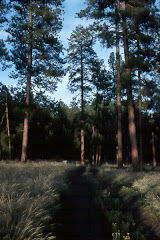
Watched the TED talk by Murray Gell-Mann a bit ago. It brought back long ago memories of the Santa fe Insitute, its intriguing focus, and the beautiful southwestern view falling away from its doorstep. Complexity science and a very, human quest to push the envelope on understanding the world about us. But part of my need I suppose in thinking a bit further on this is that geographic landscapes hold a particularly strong attraction for me. Growing up in the wooded hills of Pittsburgh and my walks with Sal (a half German short-hair pointer and black lab), or the short Robin Hood forays with my recurve bow, or the days when I pushed myself to overcome an injury that I suffered in high school as I immersed myself in the nooks and crannys surrounding our home there in Lincoln Place. Pittsburgh, albeit not as glamorous as the polished, sandy Southwest carries a steadfast, storied landscape carved into southwestern Pennsylvania and etched by the three rivers.  So too, consider two years into a Guatemalan land of tropical sun and sand, two years into a high Sonoran desert, another six or seven years in a transitional boreal forest along the international boundary with Canada, or the present home in east-central West Virginia. It makes me smile because I know the twists and turns of my life are leading me on.  And as our children emerge from our oft-times, too close hold on their paths, they too will engage themselves into a world that is more diverse than one can really imagine.  It is that world out there that may engage you or your loved ones in an intricate dance with life that may only be understood in passing. It is a venture that I would suggest that you must volunteer yourself and allow yourself to play across the providential winds that blow. The first photograph that I added to this post is of bear grass, found within the ancestral grounds of Apache clans in the southwest.  The grass of yesterday was used for many uses. I spent a couple of years working with San Carlos Apache Nation. I do not easily forget the people or the land.

I think if I were gifted as a Bard of old I might regal you with tales of the past, but perhaps over time I can reveal something of those lands that might engage your curiosity...
_____________________________________________________

In honor of those many individuals across the world that in normal times, from Guatemala to Ethiopia, struggle to simply survive. And then too to those in Haiti and Chile, those who are now arising with the morning sun and praying for a hopeful day.  Toward...

Thursday, February 25, 2010

2010 ESRI Federal User Conference

February 16 - 18, 2010
Washington DC Convention Center


Historical Context:
Over three thousand people have registered for this year's three-day conference. This is the fifteenth year for the conference that originally started with a small group of individuals at the National Geographic Society. The conference has been sponsored by ESRI and other GIS-industry companies down through the years.

Highlights:
Jack Dangermond characterized this year’s conference as “The Geographic Approach for the Nation.” He captured the GIS past in pictures with music in telling a story as to the contemporary context for applying GIS today. As always his message is one tinged in hope of being able to surmount the many cultural and societal obstacles in our day by using and applying geographic-based tools. He cited a multitude of applications across a seemingly widening array of military, business and natural resource fields. Jack drilled into a number of applications during his talk on natural resources, homeland security, facility management, military applications and law enforcement to name just a few.

The conference plenary speaker, Dr. John Holdren (President Obama’s Science and Technology Advisor and the Director of the White House Office of Science and Technology Policy), gave an effective and professional presentation on this Administration’s policies toward Science and Technology. I came away from his talk impressed. Editorializing on my own, “Science is too important not to have someone of Dr. Holdren’s stature in an advisory role to the President.”

ESRI web information on Dr. Holdren – Trained in aerospace engineering and theoretical plasma physics at the Massachusetts Institute of Technology and Stanford University, he is a member of the U.S. National Academy of Sciences, the U.S. National Academy of Engineering, and the American Academy of Arts and Sciences, as well as a foreign member of the Royal Society of London and a former President of the American Association for the Advancement of Science. Prior to joining the Obama administration, Dr. Holdren was a professor in both the Kennedy School of Government and the Department of Earth and Planetary Sciences at Harvard University, as well as Director of the independent, non-profit Woods Hole Research Center. From 1973 to 1996 he was on the faculty of the University of California, Berkeley, where he co-founded and co-led the interdisciplinary graduate-degree program in energy and resources.

Finally, every year Jack selects an individual in the Federal government who epitomizes the public servant who applies GIS in real world contexts. This year Jack honored Tim Trainor, Chief of the Geography Division, in the US Census Bureau for his work over the years.

Workshops (1 ½ hour sessions):
I personally attended workshops on ArcGIS Explorer–More than an Introduction with Brian Szukalski, Geodatabase Essentials Part 2–An Introduction to to ArcSDE Geodatabase with Tim Clark, Concepts of Geographic Analysis with Mike Sweeney, GeoMedicine with Bill Davenhall, and Using Spatial Statistics and Regression Analysis in ArcGIS with Laura Rosenshein.

ArcGIS Explorer – Brian focused on the new features coming out in March as part of the 1200 Build (a Silverlight Build will be released in April and a second Build 1500 will appear with the ArcGIS 10 summer release). This is a “connected application” that, because of its ability to be customized (as part of an Application Configuration Manager or ACM), holds potential as an enterprise-wide application for “the masses.” Brian discussed ArcGIS Explorer’s use of Microsoft’s ribbon interface. He also demonstrated the use layer packages and the ability to encapsulate data and symbology (recommended). The ArcGIS Explorer projection utilizes the Web Mercator auxiliary sphere that is used by Google. It is a 256 x 256 tiling scheme that is easy for mashing. The basemap gallery has also been updated for the new release. There was way too much information presented to cover here, but go to ESRI’s Resource Center for more information.

ArcSDE Geodatabases – Tim Clark covered a lot of ground that many of you are probably already familiar with. I won’t go into any details, but you can navigate to the ESRI web site for more information.

Concepts of Geographic Analysis – Mike Sweeney’s talk was focused on the basics for doing geographic analysis. Since all of us use geographic analysis on a regular basis through ArcGIS Toolbox I won’t mention the basics of his presentation. It is good to know though that there are a plethora of resources through the web (for example, ESRI’s help resources have improved over the years), in books (ESRI’s especially and including ESRI’s library), or at various governmental agencies (such as USGS, etc). Simply google/yahoo/search the web and read to your heart’s content. And don’t forget some of the blogs that are out there. They are excellent resources. In terms of blogs check out these – ESRI, James Fee, Michalis Avraam, Lizard Tech, and the Geo-Jobe blog to name just a few.

GeoMedicine –Bill Davenhall (see TEDMED talk) covered a lot of ground in emphasizing the importance of geography to your personal health. For more information, and to create your own map, go to the ESRI web site on GeoMedicine.

Using Spatial Statistics and Regression Analysis in ArcGIS – Laura Rosenshein gave two 1 ½ hour sessions on “Using Spatial Statistics” and “Regression Analysis in ArcGIS,” respectively. They were excellent session that I particularly had an interest in. What made the sessions even better is that she used ArcGIS 9.3.1 and ArcToolbox the whole time. In the Spatial Statistics session Laura focused on first, descriptive then inferential statistics. You can access here her Powerpoint on Spatial Statistics in a health care context for a good idea in terms of what she presented in the workshop. The second workshop was devoted to Regression Analysis in ArcGIS. Here is a link to an ESRI tutorial on Regression Analysis. Laura also demonstrated the use of Group Animation. She made it look easy (recommended). [As an aside click here for an interesting read in Directions Magazine about Laura and her career choice. Another aside, Laura mentioned she had someone ask her how fast of a computer do you need to run ArcGIS Desktop. Laura said it “depends on how fast you want ArcMap to work.”]

Reception:
The annual Fed User Thursday evening reception was held at the National Building Museum in DC. Sponsored by ESRI and other “GIS firms,” the reception was an incredible way to network in a beautiful venue. Regretfully, I missed my opportunity to meet the WWII Navajo Code Talkers who happened to be there for another meeting.

Geographic Serendipity:
As always there is some geographic serendipitous occurrence during the three day conference. My choice for 2010 is of a friend who wanted to go on a White House Tour. The day before he was to leave for DC from his Minnesota home and workplace he received an email from his Congressman that yes, indeed he would be able to go on a White House tour the next day (after he had been turned down). As luck would have it, my friend, happened to notice that the Dalai Lama was on the other side of the roped off area enjoying a White House tour with a staffer at the same time that his tour group entered the room.

Closing Session:
Damian Spangrud emceed the closing session in talking about Mobile GIS and Imagery with the help of demonstrations (including one using an iPhone).

Following Damian, Jack gave his customary closing for the conference as he interacted with participants and asked for input on the 2011 conference (slated for February 2nd through the 4th).
It was a great conference and I am already looking forward to next year and the glorious evening reception that Jack has made into a “Where’s Waldo…” Highly recommended for all GIS users!

Thursday, February 4, 2010

Ticket-giving and other curious acts

I don't think that Sean Medlock had an easy time crossing the street yesterday.  Talk of up close and personal. Go ahead and read this article. Heck of a way to receive a ticket while Sean was in a hospital bed. But Sean's 'accident' was quite a bit different than the Pittsburgh assistant coach who was hit with a coin under his eye almost at the same time. I'm sure Governor Joe Manchin was aghast at this turn of events.  WVU coach Bob Huggins has had to speak to the fans at least one other time because of a throwing incident in Morgantown regarding crowd behavior. Bottomline though is that the University has been less than serious about controlling the behavior. Makes one wonder why.  It is as if there is a group of decision-makers in the state that tout the backward behavior. I think they need to read the Louis L'Amour "Sackett" series or at least those standard sportsmanship readings that are often given at high school sporting events...

And in banking, is Congress making much of an effort to investigate the "Mystery Men of the Financial Crisis?" Not hardly, as I would suspect that this effort is a bi-partisan affair. And so it goes...

And back to sports, at Duquesne University they "flunked the handling of athletic cuts" the other day. Off-handedly affected players learned of their sports demise. Of course, what can one expect given the illustrious charm with which Notre Dame hired their new football coach away from Cincinnati, prior to Cincinnati's bowl game this past December. Evidently, even church-run entities suffer from the same quest for marketability and profitability.  Of course, their behavior in all likelihood is reflected in our culture too...

Go figure. The news of the day makes it seem almost pleasurable to expect a big snowstorm that will paralyze transportation, etc. Natural events may be and can be tragic, but somehow, at least the anticipation makes it seem easier to accept.

Let's hope that we learn from our behavior and perhaps even administer penalties for those behaviors.  When it is all said and done though it comes down to you and I.  It starts right here...

Speaking of which my back blade on my tractor broke the other day.  I guess that is why this snowstorm is coming. I may be shoveling a bit. Then again breathing my last under a deep, white coating of snow might be heaven :).

Sunday, January 10, 2010

The Right Way

Well, I made it up the hill on my x-country skis today. It's only about a 200 feet change in elevation from our home set at about 2,000 feet. And I haven't waxed my skis recently so they are a bit slippery in the powdery snow. But I made it - three stents and all. The last week or so I have finally gotten a bit of exercise after a quick trip to New England. Racquetball, swimming and now pushing snow on my skis. Feels good, but it seems that I have a pretty tranquil life, eh. I learn from my PC Internet sedentary reading position of dolphin slaughters in Japan (from the documentary "The Cove")deaths in the nation's immigration jails and green issues on a global scale.  And we won't even mention Iraq or Afghanistan.  Yes, there is plenty to keep one's eye on (and these links are but a mix of links and little at that), but at the same time we can count ourselves lucky if we have a decent job, shelter and some food on the table.  Like most of the rest of us I don't really have a prescription for tackling all of this and I really don't have a crystal ball that can foretell what is around the bend.  But I suppose we can chip away at things. You know, sort of like Copenhagen. We can all smile and nod our heads because meetings whether in your own home, at work or on the world stage meetings often times end up with less than what we had hoped for, but if fate is good to us with more than before...


Once on the hill, the dogs and I paused for a few moments to capture the valley scene below. It is a beautiful day with blue sky and white snow. The hard part is doing the herringbone up the hill.  The easy part, albeit more dangerous, is racing downhill. I suppose that is the way I look at society right now.  We are racing downhill without any real and overt means by which we can stop. What we can do though is to use our senses to tell us that there is an end to the downhill slope. In my mind that only works though for those who are true to heart and value. Hmm, you wonder what I mean by that. Aye, it is a naive view of the world that guards a rigid sense of right and wrong. Clarity in action in relying on your instincts and a faith that GTC has made us all with a place in this glorious wide world. Easier said than done for sure, but it takes practice...


I look back up the hill at the trail that I have left behind. Two muffled tracks of soft, powdery snow settle in for a short winter time. It is always fun to do "downhill" in a powder. Yes, I did tip over once halfway down. Kelpie and Griffon stopped by to make sure that I was okay. The final slope though was still fun. That's it I think in terms of reaching that final slope. Just how do we un-corrupt a very, complicated and diverse world in order to reach that right way of living to sustain ourselves and each other. And I wonder how many of us include the each other part of the equation. Because we must...


1 In that day this song will be sung in the land of Judah: We have a strong city; God makes salvation its walls and ramparts. 2 Open the gates that the righteous nation may enter, the nation that keeps faith. 3 You will keep in perfect peace him whose mind is steadfast, because he trusts in you. 4 Trust in the LORD forever, for the LORD, the LORD, is the Rock eternal. 5 He humbles those who dwell on high, he lays the lofty city low; he levels it to the ground and casts it down to the dust. 6 Feet trample it down—the feet of the oppressed, the footsteps of the poor. 7 The path of the righteous is level; O upright One, you make the way of the righteous smooth. 8 Yes, LORD,
walking in the way of your laws, we wait for you; your name and renown are the desire of our hearts. 9 My soul yearns for you in the night; in the morning my spirit longs for you. When your judgments come upon the earth, the people of the world learn righteousness.
 

Tuesday, December 8, 2009

up front and a little too human


tonight the raucous weather front is here. the rain is coming down on the bit of remnant snow left behind. the wind is carrying bits and pieces of what has risen from the past. not sure if the waters will reach the bridge deck. it isn't really unusual. and so we have learned to deal with it. 

somehow i don't think we deal or really tolerate humanness vey well. well, it isn't the sort that you hold out front. the clothes we wear, the face we carry, the acts we plot and do behind the scenes. what a fix we are in. because more often than not we just don't seem to have a right way to tackle those difficult issues.

and i guess it begs a question of how do you really contemplate if not actually doing it. you know, starting over. ok a new direction, but with a past.

innovate living and working together and novel ideas in a novel way.

novel ideas, huh.

i like to stand in a stiff wind. to feel the rain pelt against my face. a glance at the sky and either disappear into the grayness or to ride along on the clouds.

a peak of blue can bring a smile and a reminder that there is hope.

the hope of a creator and the courage to face uncertainty and the hard decisions that your (our) times may dictate.

what is it, james said faith and works. and maybe the feather that forest talked about. what is it "light as a feather" jesse talked about. no, not the biblical jesse either. but then again, yes maybe...

i'm listening now.

it's i dreamed a dream. perhaps storms we cannot weather, but yes, storms that will pass by. i suppose we are all dust in the wind. yet, one hopes that copenhagen brings hope. hope that we can work together. i think that real humanness is rising to the real challenge of growing our garden together. with All the Biological World in uniting to make a common future. those that hear this call will understand. it is for those in copenhagen. that they may listen and God may show. show us the path to a common light.