Thursday, May 7, 2026

Evening Wildflower Walk in the Sweathouse Creek Conservation Easement

The Bitterroot Valley, May 2026


The invitation arrived the day before. Owen Yager of the Bitterroot Land Trust sent word that the organization was hosting a special guided wildflower walk for donors and supporters — a thank-you for their participation in Bitterroot Gives, which had just unlocked $15,000 for conservation projects up and down the valley. The walk would be led by Bitterroot National Forest staff including botanist, Laura Johnston and her assistant Hannah, a forestry technician. BRLT Next Gen Committee members and the public, would meet at the Sweathouse Creek trailhead at five o'clock. The temperature was forecast to be in the sixties. 

That is the practical summary. What actually happened was something closer to a tutorial in reading landscape.


The Bitter Root Land Trust works across the full length of the Bitterroot Valley, protecting what it describes as water, wildlife, and working lands. Since its founding, BRLT has conserved more than 15,000 acres through 70 conservation projects, keeping 53 miles of river and stream frontage undeveloped and green. In 2023 the organization received the Land Trust Excellence Award from the Land Trust Alliance, selected from among 1,000 partner land trusts nationwide. More information at bitterrootlandtrust.org.

The Sweathouse Creek Conservation Easement, on the west side of Victor, was conserved by the Hackett family in 2023 in partnership with Montana Fish, Wildlife and Parks, BRLT, and other local partners. The 540-acre easement borders the Bitterroot National Forest and holds the trailhead to Sweathouse Falls. It protects important agricultural land, public access, and valuable plant, fish, and wildlife habitat. The walk Owen organized that evening was one expression of what stewardship looks like in practice — not just holding land in conservation, but understanding what it contains.

After introductions in the parking lot, Laura didn't wait to begin. She turned to the treeline at the lot's edge and started naming what she saw. Grand fir — flat, two-ranked needles, smooth gray bark, a shade-tolerant species that moves into ponderosa parkland when fire is suppressed. Ponderosa pine — plated orange-gray bark, long needles in bundles of three, the signature tree of the valley's lower slopes. Cottonwood and aspen anchoring the riparian edge, their new leaves catching light. Aspen trembling at the meadow margin. Four species, four different ecological stories.

I asked about whitebark pine. Laura nodded — yes, it's in the range, but at higher elevations. Not here. Whitebark pine (Pinus albicaulis) is a subalpine species, found near treeline in the Bitterroots and across the Northern Rockies, where it plays an outsized ecological role as a source of high-fat seeds for Clark's nutcracker and grizzly bear. It is also a species under serious pressure — listed as threatened under the Endangered Species Act, declining across its range from white pine blister rust, mountain pine beetle, and a century of fire suppression that has allowed shade-tolerant competitors to crowd it out. Laura's answer placed it precisely: the whitebark belongs to a different elevation, a different community. What we were about to walk through was something else.

We set out up the road toward the gate entrance to the property.


Sweathouse Creek was running full — snowmelt white over moss-covered boulders, alder leaning into the current from both banks, a small diversion structure managing the flow toward the valley's irrigation network below. The Bitterroot Range is carrying ninety percent of normal snowpack this spring, and you could hear it in the creek. The mountains are not scenery here. They are the water supply. The Bitterroot Valley's farms and ranches have depended on snowmelt off this range for as long as people have worked this land, and the irrigation channels that distribute that water are as much a part of the valley's ecology as anything growing beside them.

Sweathouse Creek

Just before the gate, on the dry road shoulder, something grew that looked unremarkable — grass-like leaves, a flower spike just emerging, a small pink flag beside it. Laura stopped the group there. Toxicoscordion venenosum — meadow death camas. Laura and Hannah had been here before us, walking the property in advance, placing flags at every specimen she wanted the group to see. This was the first lesson, delivered at the threshold.

Death camas is a plant that exploits resemblance. Its grass-like leaves look like wild onion. Its white flower spike looks, at a certain moment in spring, like edible blue camas (Camassia quamash), the bulb that fed Indigenous peoples throughout this region for thousands of years and that Lewis and Clark's Corps of Discovery ate in quantity near the Lolo Trail not far from here. The confusion is not carelessness. It is the product of ecological proximity — the two plants share similar habitats and bloom at the same time of year. Every part of death camas is toxic — bulb, leaf, flower. Livestock have died from it. People have died from it. Laura named it plainly and moved on. The flag stayed in the ground.

Hannah held up her phone so the group could see: the field ID app confirmed the identification, the Latin name stark against the image.

iPhone App and Death Camas

We passed through the gate.


The site beyond is a conservation easement — land protected from development, held in trust for the ecological values it carries. Part of BRLT's ongoing stewardship work is understanding what those landscapes actually contain. That is where the Forest Service partnership matters. Laura Johnston and Hannah carry the scientific vocabulary and the field instincts to inventory a place systematically. Amanda Kimball, BRLT's lands coordinator, was there to document alongside the group. 

We started at the dry end of things.

Upslope and Wildflowers

The rocky hillside above the valley floor held a community of plants adapted to shallow soil, fractured substrate, and full exposure. Indian paintbrush (Castilleja sp.) flared red-orange from the talus. Arrowleaf balsamroot (Balsamorhiza sagittata) spread its large basal leaves across the slope, the yellow flowers just past their peak. Creeping Oregon grape (Mahonia repens) held its yellow flower clusters low to the ground, its holly-like leaflets edged in purple-red. Silky lupine (Lupinus sericeus) had pushed up through the needle duff, its blue-violet racemes compact and precise. These are plants that know drought, that have made their arrangements with thin soil and long summers.

Laura Johnston, Bitterroot National Forest botanist, pointing out specimens along the forest edge

Laura and Hannah moved through this community with the ease of someone reading a familiar text, pointing, naming, noting. Pink flags marked every stop — their advance work making each pause intentional.

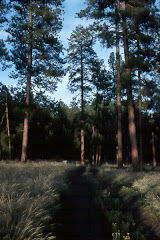
The ponderosa pines above were open-grown, their canopies high and wide, their bark plated in deep orange and gray. In the needle duff at their feet, young seedlings had germinated — small constellations of needles, each one a potential century. Western larch appeared in the mix as well, its needles soft and clustered — a deciduous conifer that would go gold in October and drop every needle before winter, a fact that still surprises people who expect all conifers to be evergreen. The small cones in the duff told a story of regeneration: this forest was doing what healthy forests do, given the chance.

Creeping Oregon grape (Mahonia repens) in yellow bloom

Indian Paintbrush


Then the gradient shifted.

Moving toward the meadow, the soil deepened and darkened. Serviceberry (Amelanchier alnifolia) crowded the shrub layer, its pale flower buds still tight against red-tinged stems — in a few weeks it would be white with bloom, and later in summer the dark berries would feed birds and bears alike. Rocky Mountain maple (Acer glabrum) opened its fresh leaves and small flower clusters in the moist draws, the new growth nearly chartreuse against the darker forest. Alder thickened along the drainage edge, its spent catkins still hanging dry and articulated while fresh leaves opened around them. Chokecherry (Prunus virginiana) was leafing out as well — and on one branch, a thick black mass of Apiosporina morbosa, black knot fungus, a disease the valley's cherry family carries. Laura pointed it out without alarm. It is part of what the land holds.

Someone asked about the aspen grove at the meadow edge — whether those were all separate trees. Laura explained what the roots are doing underground: how what looks like a grove of individual trees is often a single clonal organism, one root system sending up hundreds of stems, potentially covering acres, potentially thousands of years old. You are not looking at a forest of separate things, she said, in effect. You may be looking at one thing. The group was quiet for a moment with that.

Then we stepped into the meadow, and a Western meadowlark was singing somewhere to the west. A California quail called from the shrub edge. The light was going golden.

Entering the Meadow

Amanda Kimball had dropped to one knee in the meadow grass, turning a sedge specimen in her fingers, examining the sheath, the ligule, the seed head. The sedges — Carex and its relatives — are among the harder genera to work with in the field, but they are among the most important ecologically. Where sedges grow, water moves slowly, soils stay moist, and a different suite of animals finds what it needs. 

Amanda Kimball and Sedge Specimen

Ponderosa in the Meadow


What a conservation easement protects, in the end, is not a single species or a single view. It is a gradient — from the dry road shoulder where death camas waits at the gate, through the talus where paintbrush burns red and ponderosa parkland where lupine blooms in the duff, down into the wet meadow edge where sedges root in the dark soil, where alder crowds the drainage and snowmelt finds its way toward the valley floor and the irrigation channels beyond. The gradient is what matters. Protect only the pretty parts and you lose the functional whole.

Ponderosa in the Evening Light

Laura Johnston and Hannah brought their Bitterroot National Forest expertise to private land that evening because the partnership between BRLT and the Forest Service recognizes what a single institution cannot hold alone. Laura had walked the property before any of us arrived, placing flags, preparing the lesson. The science of what a landscape contains belongs to everyone who lives beside it — but first, someone has to go out and learn it.

We finished sometime after 6 at the Sweathouse Creek trailhead. The meadowlark was still singing.


Sam Lammie & Claude


Tuesday, May 5, 2026

By the American Shore in WWII - What the Landscape Required

 The Ecology behind Naval Air Station Tillamook

The Musical Stone — Sam Lammie, in collaboration with Claude (Anthropic)


The road south out of Tillamook follows the bay edge before bending inland, and if you are paying attention, you will see it before you can make sense of it. A wall — a brown, corrugated, curved wall — rising from the valley floor with a scale that defies easy calculation. No context prepares you. Nothing nearby is remotely its size.

This is Hangar B. It is 1,072 feet long, 296 feet wide, and 192 feet tall — seven acres under a single roof, built in 1943 by the United States Navy from Douglas fir timber on a wartime schedule, with no serious injuries reported on the entire project. It is among the largest wooden structures on Earth. It was built to house blimps.

Tillamook Air Museum

I have been here twice now. The difference between those two visits captures something important about the fragility of the things we build and the urgency of capturing them before they are gone.


Inside, 2024

The first time, I walked in. That is a sentence worth sitting with — walked in — because the experience of crossing the threshold of Hangar B under normal museum conditions is genuinely disorienting. The wooden truss structure overhead disappears into darkness. The floor stretches ahead of you like an airfield. The scale does not resolve; it simply continues.

On one wall, a graphic chart maps the comparative lengths of airships across the history of lighter-than-air flight. The Hindenburg at 803 feet. The USS Akron at 785 feet. Then descending through the ZPG-3W, the N-Class, M-Class — and finally the K-Class at 252 feet, the workhorse blimp this hangar was built to shelter. Modest by comparison, but still enormous: longer than two 747s parked nose to tail. The hangar's own length — 1,072 feet — is marked at the bottom of the chart. The K-Class blimps fit with room to spare. Eight of them at a time.

Blimp Scale Chart

Across the floor, an F-14A Tomcat sits under the lights. Tail markings identify it as VF-14, the "Tophatters," assigned to the USS John F. Kennedy. Bureau number 159848. One of the Top Gun production aircraft, now here in a WWII blimp hangar on the Oregon coast, someone's work buckets on the wet floor beside it, restoration underway. The juxtaposition is almost too much — Cold War naval aviation artifact inside a Second World War lighter-than-air infrastructure, both fighting obsolescence on different timescales.

F-14 Tophatters

Nearby, the forward fuselage section of a B-52 Stratofortress sits on a yellow cradle, nose art reading Osiris — the Egyptian god of the dead rendered in classic wartime pinup style, serial number 2579 still legible, the Air Force shield still crisp. The dead god presiding over the dead aircraft in the living hangar.

B-52 Nose Section

What holds it all together — literally — is the Douglas fir overhead. Those trusses were raised in 1943 under wartime urgency, no serious injuries, the whole project completed on a military schedule that would be unimaginable today. The wood has darkened but held. Standing beneath it, you understand that the builders knew something about permanence that the era of steel and concrete has partly forgotten.


What the Valley Required

The Navy did not choose this valley arbitrarily. They were reading a landscape, and the landscape had been shaped by forces operating on timescales that make wartime urgency look brief.

Tillamook sits at the confluence of five rivers draining the Coast Range — the Tillamook, Trask, Wilson, Quilcene, and Miami — all emptying into Tillamook Bay, one of Oregon's largest estuaries. The bay is a drowned river mouth, a product of Holocene sea-level rise filling a valley the rivers had already been building for millennia. The sediment those rivers deposited across the valley floor created something rare on the rugged Oregon coast: flat, stable ground, large enough to maneuver lighter-than-air craft, close to open water.

The maritime climate sealed the logic. Annual precipitation runs 80 to 100 inches. Persistent coastal fog — driven by cold upwelling water offshore — moderates temperatures year-round. Perennial ryegrass and clover grow almost without interruption. These conditions made Tillamook ideal for dairy farming, which is why the county had the infrastructure — roads, rail, power — that military logistics required. The same geomorphic processes that built the dairy pastures built the airfield. The Navy was, whether they thought of it in those terms or not, reading an ecological system and embedding within it.

Seen from across the valley floor, with the Coast Range rising behind and the dairy pastures running green to the hangar's base, this is almost visually self-explanatory. The mountains drive the rainfall. The rainfall feeds the rivers. The rivers build the plain. The plain supports the farms and, in 1942, the station. One photograph contains the entire argument.


The Threat Offshore

The strategic logic was equally ecological. Japanese submarines operated in Pacific coastal waters in the months following Pearl Harbor, targeting shipping lanes with enough success to create genuine alarm. The Oregon coast's proximity to those lanes made blimp patrol coverage a military priority.

What made those lanes worth protecting was itself an ecological fact. The Oregon coast sits atop one of the world's most productive marine upwelling systems — cold, nutrient-rich water driven to the surface by offshore winds, fueling phytoplankton blooms, forage fish, salmon, Dungeness crab, and the entire food web built on top of them. Commercial fishing, timber transport by sea, military logistics — all converged in that same nearshore zone. The ecology that made the coast biologically extraordinary also made it strategically significant.

The K-Class blimps stationed here — eight of them, each 252 feet long, filled with 425,000 cubic feet of helium, capable of staying aloft for three days and ranging 2,000 miles — were well suited to the task. Patient, slow, able to loiter over convoys, effective enough against submarines that the mere presence of a blimp overhead was often deterrent enough. The fog that is so characteristic of this coast complicated blimp operations but also obscured coastal movement from offshore observation. Microclimatic ecology as tactical variable.


Outside the Fence, 2026

The second visit was different.

On December 18, 2025, severe winds tore open a section of Hangar B's roof — roughly 170 feet long and 30 feet wide — leaving the structure exposed to the elements and forcing indefinite closure. When I returned in spring 2026, I could not go inside. The fencing had been extended around the perimeter. The concrete portal frames of the end-wall door supports rose above the road — those massive pylons, fifteen or twenty stories of wartime engineering — but the doors they once supported were gone, or going, and the hangar itself was closed to the public for the first time in decades.

Hanger B Exterior - Damaged Roof

Concrete End-wall Door Portal Frames

The Stratocruiser outside the fence line was still there, weathering. The Tophatters F-14 was inside, inaccessible. The Osiris B-52 nose, the scale chart, the Douglas fir trusses — all of it behind chain-link and caution tape while engineers and fundraisers worked out whether $20 million, or $30 million, or $50 million could be found to stabilize and restore a structure the National Register of Historic Places has recognized as irreplaceable.

Boeing Stratocruiser/C-97

A lidar drone has been flown to create a three-dimensional structural model. Federal funding requests have gone to the offices of Senators Wyden and Merkley. The Friends of Tillamook Air Museum have launched a Save Hangar B campaign. Repairs are not expected until 2027 at the earliest.

This is where history lives when institutions are fragile: in the gap between what a place contains and what it costs to keep it.


Why Capture Matters

I am a geospatial professional by training and career. I spent decades working with the tools and disciplines that document landscapes, structures, and change over time. The lidar scan being used to assess Hangar B's storm damage is the same basic technology I worked with for years on the National Forests — point clouds, structural models, change detection. It is gratifying that it is being applied here. It is also a reminder that documentation is not preservation. A perfect three-dimensional model of a collapsed building is still a record of loss.

The photographs I made inside Hangar B in 2024 are primary documents now. The F-14 under the lights, the truss work overhead, the scale chart on the wall, the Osiris nose section in its yellow cradle — these images capture a moment that may not return, or may return changed in ways that cannot be fully anticipated. That is what photographs do when institutions are in crisis: they become the record that survives when the thing itself does not, or not in its current form.

This is not unique to Tillamook. It is the condition of physical heritage everywhere — contingent, expensive, vulnerable to the same forces that built it. The same coastal storms that made this valley's climate hospitable to dairy farming and blimp operations are the storms that peeled back 170 feet of Hangar B's roof in December 2025. The landscape gives and takes on its own schedule.


What Persists

The valley is still dairying. The bay is still ecologically stressed — agricultural runoff from those same fertile pastures continues to challenge water quality and salmon habitat, a tension that was present in 1942 and remains unresolved. The upwelling offshore still drives one of the world's most productive marine ecosystems. The fog still comes in off the cold water, still moderates temperatures, still shapes what grows and what is possible here.

The Navy read this landscape correctly in 1942. They found what they needed because ecology had already organized it. What they built in response — the hangars, the station, the patrol network — was immense and consequential and is now mostly gone or imperiled. One hangar burned in 1992. The other is fighting for its life.

But the ecological logic that selected this valley has not changed. The rivers still build their plain. The mountains still drive the rainfall. The upwelling still feeds the nearshore. If Hangar B survives — if the funding comes through, if the Douglas fir holds, if the storms relent long enough for the repairs to be made — it will stand because human intention and institutional capacity aligned, however temporarily, with the same geographic permanence that put it here in the first place.

If it does not survive, the valley will continue without it. The fog will come in off the upwelling. The grass will grow in the rain. The concrete pylons will stand a while longer, and then they too will go.

History requires witnesses. It also requires the structures that make witnessing possible. Right now, Hangar B needs both.


Photographs by the author. Interior images: Tillamook Air Museum, 2024. Exterior images: Tillamook, Oregon, spring 2026. To support the Save Hangar B campaign, visit tillamookair.com.


The Musical Stone is written by Sam Lammie. This post was developed in collaboration with Claude (Anthropic) as a research and writing partner. themusicalstone.blogspot.com