On the charge that the environmental industry “captured” the Forest Service — and what the charge gets wrong
A response to Franklin Otis Carroll’s “How the Forest Service Didn’t Fail Us” — Facebook, June, 2026.
Carroll’s argument — that the Forest Service was captured by an environmental industry, and that cutting its partnerships is the first step toward restoring it — is not wrong about everything, and the honest place to start is with what it gets right. The multiple-use mandate has been hollowed out. Active management did decline. Roads fell into disrepair, fuels built up, and in a great many western communities the agency lost the trust of the people who live closest to the trees. I spent thirty-five years in federal service and the majority as a Forest Service employee — fifteen as GIS Coordinator on the Monongahela, a stretch with line authority as Acting District Ranger on the Cheat–Potomac, and a last chapter as geospatial program manager for the Northern Region, responsible for the spatial record across twenty-five million acres in Montana, Idaho, and the Dakotas.
But the diagnosis is wrong, and it is wrong in ways that matter.
Begin with the exhibit the essay leads with: the decision to sever forty-three partnerships and claw back roughly four million dollars from groups said to be operating “in direct opposition” to the mission. The essay names that correctly as an Interior Department action — and then asks it to carry weight it cannot bear. The groups Interior cut were flagged for climate advocacy, equity, and immigration support; the named examples were Conservation International and a cultural-landscape preservation foundation. None of it touched timber, fuels, or fire — the actual subject of everything that follows. And in a related round of terminations the same department pulled a set of conservation grants, money funding native-species and habitat restoration by groups like the Institute for Applied Ecology, that a federal court in Oregon has since ordered restored, finding the cancellations a purge by political viewpoint rather than any audit of performance. So the opening “audit” does rhetorical work, not evidentiary work: it signals that the tide has turned against the activists without establishing a single thing about how the Forest Service manages fire.
The capture story is the load-bearing claim, and it has the history backwards. The multiple-use mandate did not bend because lawyers “moved in.” It bent because Congress rewrote the agency’s orders, in daylight, over two decades — the Wilderness Act of 1964, the National Environmental Policy Act of 1969, the Endangered Species Act of 1973, the National Forest Management Act of 1976 — much of it signed by Republican presidents.
And here I can speak from the ground this argument is standing on. The National Forest Management Act, the modern charter of all national forest planning, exists because of a clearcutting lawsuit on the Monongahela — the forest where I spent fifteen years. A federal court read the 1897 Organic Act as written, found that clearcutting violated its plain terms, and effectively halted the timber program until Congress acted. The author would call that capture. I call it the system Pinchot built doing precisely what it was designed to do: when the agency drifts from its founding law, the courts and Congress pull it back. That is not an industry mining the government. That is the rule of law, working as intended, on the very ground this piece claims to defend.
It is worth adding that the agency had overshot. In the postwar boom it became, in the scholars’ phrase, a regional employment “lunch bucket” — a timber-first operation wearing a multiple-use motto while timber took the major use. The correction came from a changing society and the laws it passed, not from a conspiracy in Ventura.
And the agency did not become the Park Service. This is the essay’s sharpest mischaracterization — the claim that the Forest Service traded its working charter for a preservation model unsuited to lands meant to be worked. It did no such thing. It still sells timber, runs grazing allotments, permits minerals, builds and maintains recreation, and manages for wildlife and water — the same multiple-use mandate it has always carried, and one fundamentally different from the Park Service’s preservation charge. What changed is not the mandate but the balance within it, and the arrival of ecosystem health as a frame. That is evolution, not surrender. Multiple use was never a fixed ratio. It was always a negotiation, and the negotiation matured.
Even wilderness — the part the essay quietly files under “museum” — is a form of use, and one of the oldest. I have believed in wilderness since I was old enough to carry a gun, and I have never felt the contradiction the author assumes. Wilderness on a national forest is not a national park: it still carries hunting, fishing, packing, and outfitting, the hook-and-bullet tradition that built American conservation in the first place. Stand on a Bitterroot trail in the fall and watch a hunter bring a quartered elk out on his back, and then try to tell that hunter wilderness is the enemy of working land. The people who use that country hardest are very often its fiercest defenders. The author has mistaken restraint for abandonment — and the two are not the same thing.
And multiple use is not a slogan. It is a payroll. I have worked, in one capacity or another, across most of the agency’s program areas — timber and aquatics, recreation and wildlife, and the dozen-odd others the public rarely hears named: hydrology, soils, range, fuels, heritage, lands, minerals, engineering, the geospatial work I spent a career on. A national forest is run by something close to twenty professional disciplines, not by foresters alone and certainly not by lawyers. The essay’s picture — the foresters let go, the briefcases moving in — erases that entire workforce, the people who actually deliver the “multiple” in multiple use.

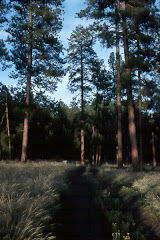
Ponderosa Fuel Treatment - North of Flagstaff
And it leaves out the half of the founding equation that matters most. The author lists watershed once, in a passing string of uses, and then forgets it. But the national forests were never created only to grow timber. The Organic Act of 1897 — the same law the Monongahela case turned on — gave the reserves two coequal purposes: to furnish a continuous supply of timber, and to secure favorable conditions of water flows. Water was there at the creation. It is not a soft amenity bolted on later by activists; it is why a great many of these forests exist at all. They are the largest single source of water in the country — roughly a fifth of the nation’s supply — and by the agency’s own accounting some 180 million people in tens of thousands of communities depend on national-forest watersheds to catch and filter what comes out of their taps. Manage these lands as nothing but a timber base and you have not restored their mission. You have forgotten half of it.
None of this is to pretend NEPA litigation is costless. It isn’t. Environmental analysis consumes something like a fifth of the money available to manage the national forests and close to a third of the agency’s field capacity, and the threat of suit does delay treatments that need to happen before the fire season. I have prepared those documents and lived inside that process; I will not romanticize it. But the picture of an agency paralyzed and forever losing is a caricature. Across the suits filed against it over a representative stretch of years, the Forest Service won more than it lost. NEPA’s burden is real — and it is a problem of process and capacity, not evidence that the agency was conquered.
On fire, the essay wants suppression and the collapse of active management to be rival explanations, with climate change cast as the activists’ alibi. Start with the history it skips. Fire suppression was not an environmentalist invention — it was the Forest Service’s own founding doctrine. The agency was forged in the Great Fire of 1910, the Big Burn that took some three million acres and dozens of lives across Idaho and Montana, in the country I now live in. Out of that trauma came a policy of total fire exclusion, hardened into the 1935 “10 a.m. policy” and sold to the public for a generation by Smokey Bear. That was the agency talking to itself, decades before NEPA existed or the modern environmental movement was born. And when the science finally turned — when ecologists began arguing that these forests need fire — it was largely conservationists, not commodity interests, who pushed to put fire back on the ground. The author has the arrow backwards. Suppression is the original sin here, and it is the agency’s, not the activists’.
None of which lets the fuels off the hook. A century of exclusion and the decline of thinning and harvest both loaded the stands — the author is right about that — and a warming, drying climate then stretched the season and dried the fuels further. Ask the researchers at the Missoula Fire Sciences Laboratory, or the smokejumpers based up the valley from me, whether the season runs longer than it used to. Climate is not an alibi; it is a multiplier.
And there is a fact the essay leaves out altogether, because it complicates everything: the forests do not, in the main, light themselves. More than eighty percent of wildfires in this country are started by people. When you narrow to the fires that actually threaten homes, the share climbs higher still. In one large study of a quarter-century of ignitions, humans caused ninety-seven percent of the wildfires in the wildland-urban interface and accounted for ninety-two percent of the homes threatened. What burns down a community is rarely an un-thinned stand that a logger was kept out of by a lawsuit. It is a human ignition meeting an interface we keep building deeper into fire-prone woods. You could thin every acre the essay wants thinned and still lose the town if the ignition source and the building pattern go unaddressed. That is not an argument against thinning. It is an argument against the single-cause story — the very thing the essay accuses the other side of telling.
Which brings us to the owl, offered as the emblem of single-species folly, with the barred-owl removal as the movement’s bloodthirsty endgame — up to 450,000 birds, branded “wildlife ethnic cleansing.” Set aside that the phrase loans the vocabulary of atrocity to a wildlife program and cheapens both the atrocity and the genuine, painful dilemma it describes. The deeper trouble is whose program it is. The barred-owl strategy is a federal intervention, run by the Fish and Wildlife Service — Interior again — and it is opposed across the spectrum: animal-welfare groups suing under NEPA, bipartisan members of Congress, and a good many of the very environmentalists this piece indicts. The author is against intervention when it is a court-ordered chainsaw and for it when it is a shotgun. Strip that inconsistency away and the real objection was never single-species fixation. It is environmental groups as a category.
The essay also reaches for science when it helps — the fire-suppression story is “not settled,” merely “convenient” — and goes quiet about what the administration it applauds is doing to the science itself. The Chief of the Forest Service told a House appropriations subcommittee, in plain words, that research and development is zeroed out in the budget: roughly three hundred million dollars driven to nothing. The reorganization moves to close better than half of the agency’s research stations — among them the Seattle smoke lab whose work helped build the public wildfire-smoke maps that millions of families now check before they let their children outside. The long-term experimental forests, some carrying datasets decades deep, would be snuffed out with them. The Missoula Fire Sciences Laboratory I pointed to a moment ago survives — spared, it appears, because it serves the favored emphasis on fire and timber — but the broader science that would actually tell you how to build a forest that resists catastrophic fire is the part on the block. You cannot run science-based forestry once you have defunded the science, and members of both parties have said so. Zeroing out the research arm of the nation’s forest agency is not reform. It is a disgrace.
And here is the contradiction the essay never resolves. It wants active management — thinning, open roads, woods workers, fuels brought down. But the partnerships it cheers Interior for cutting are how active management actually gets done now. The grants a court just restored funded habitat restoration. Across the fence in Agriculture, the same work runs through collaborative forest landscape restoration, stewardship contracting, Good Neighbor Authority, shared-stewardship agreements with states and, yes, with conservation groups. You do not rebuild active management by firing the partners who carry it out. You rebuild it by funding and staffing the field. The essay mourns the lost forester while applauding the policy that loses more of them. The foresters I watched leave did not leave because of anyone’s briefs. They left because of budgets, hiring freezes, reductions in force, mills consolidating, and the old-growth that once propped up the cut running out — and now they leave because of the very dismantling this argument calls restoration.
The strongest line in Carroll’s piece is its insistence that the forest is a living, working whole, not a museum. I agree without reservation. But so is the agency, and so is the body of law that governs it — an ecotone of competing uses held in tension, which is the only place a multiple-use mandate can actually live. You do not restore a working whole by amputation. Defend multiple use by rebuilding capacity, not by purging the people who do the work.
I want what the author says he wants: forests that are worked and healthy, and rural communities that trust the agency again. That is reached by putting skilled hands back on the ground — not by firing the briefcases and discovering, too late, that some of them were holding the saws.
A note on sources.
USDA Forest Service. 2007. Forest Service Research Image Library. Fort Collins, CO: Forest Service Research Data Archive. https://www.fs.usda.gov/rds/imagedb
This piece was produced in collaboration with Claude, an Anthropic AI assistant. The argument, the sources, and the editorial judgments are the author’s.



No comments:
Post a Comment